
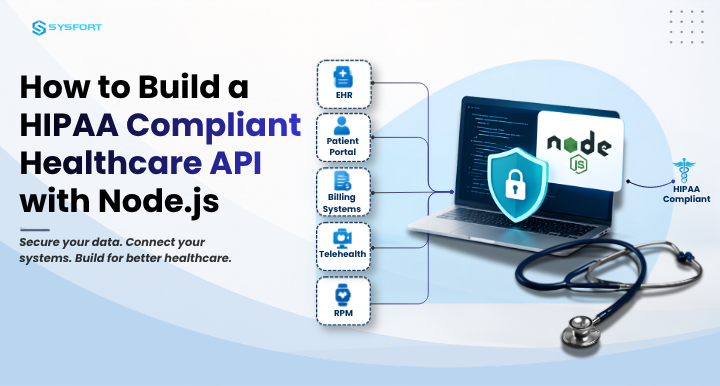
Building a HIPAA-compliant healthcare API with Node.js requires more than choosing a secure programming framework. Healthcare APIs often connect EHR systems, patient portals, billing platforms, telehealth applications, Remote Patient Monitoring (RPM) solutions, and other systems that process sensitive patient information.
When an API handles electronic Protected Health Information (ePHI), security needs to be built into every layer of the application—from authentication and authorization to encryption, audit logging, monitoring, infrastructure, and ongoing maintenance.
Node.js can provide a scalable foundation for healthcare API development, but Node.js itself is not HIPAA compliant. HIPAA compliance depends on the complete technology environment, security safeguards, policies, procedures, infrastructure, and operational practices surrounding the application.
In this guide, we explain how to build a secure healthcare API with Node.js, including HIPAA considerations, FHIR and EHR integrations, authentication, authorization, data protection, multi-tenant security, testing, and production monitoring.
What Is a HIPAA-Compliant Healthcare API?
A healthcare API is an application programming interface that enables different healthcare systems and applications to exchange data and services.
For example, a healthcare API may connect:
- EHR and EMR systems
- Patient portals
- Telehealth platforms
- Healthcare mobile applications
- Billing and RCM systems
- Remote Patient Monitoring platforms
- FHIR-based applications
- Laboratory and pharmacy systems
- Analytics platforms
If the API handles ePHI, it needs appropriate administrative, physical, and technical safeguards as applicable to the organization’s HIPAA obligations.
Why Use Node.js for Healthcare API Development?
Node.js is widely used for API and backend application development because of its event-driven architecture, large ecosystem, and ability to support scalable network applications.
For healthcare organizations, Node.js can be used to build:
- REST APIs
- FHIR APIs
- EHR integration services
- Patient portals
- Healthcare SaaS platforms
- Telehealth backends
- RPM platforms
- Healthcare workflow automation systems
- Data integration and transformation services
A Node.js healthcare API needs appropriate security controls, infrastructure, monitoring, testing, and operational processes.
12 Steps to Build a HIPAA-Compliant Healthcare API With Node.js
1. Understand HIPAA Requirements Before Development
Before writing code, determine how your application will handle ePHI.
Map the complete data lifecycle:
- How does patient information enter the system?
- Where is ePHI processed?
- Where is it stored?
- Which systems receive the information?
- Who can access it?
- How is access logged?
- How are backups handled?
- What happens during a security incident?
- How will systems be recovered after an outage?
2. Design a Secure Healthcare API Architecture
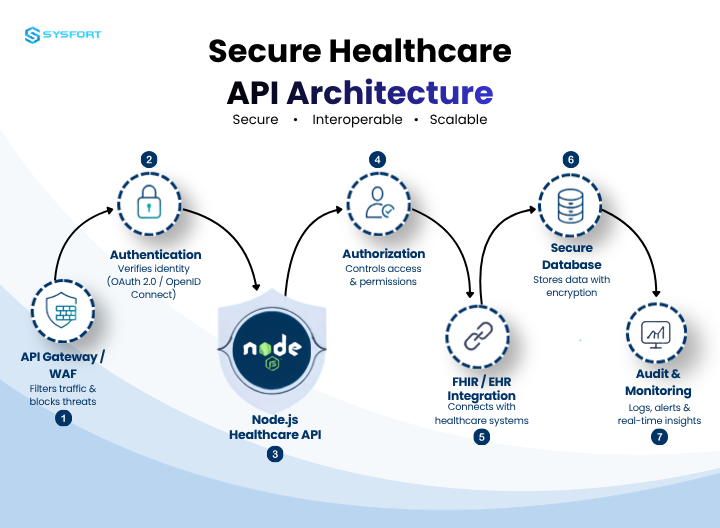
A secure Node.js healthcare API architecture should use multiple layers of protection.
A typical architecture might look like:
API Gateway / WAF → Authentication → Node.js API → Authorization → FHIR / EHR Integration → Database → Audit & Monitoring
Each layer should have a clearly defined security responsibility.
For example:
- API gateway/WAF: Traffic filtering and perimeter protection
- Authentication: Identity verification and token handling
- Node.js API: Business logic and API processing
- Authorization: Access and resource-level permissions
- FHIR/EHR integration: Secure healthcare interoperability
- Database: Protected data storage
- Audit and monitoring: Security visibility and incident investigation
A layered architecture can help limit the impact of individual security failures and provide better visibility into how ePHI moves through the environment.
3. Implement Strong Authentication
Authentication determines who or what is accessing your healthcare API.
Healthcare applications commonly use established identity standards such as OAuth 2.0 and OpenID Connect.
A secure implementation should address:
- Token validation
- Token expiration
- Scopes and permissions
- Credential protection
- Identity verification
- Session management
- Token revocation where appropriate
- Detection of suspicious authentication activity
4. Implement Role-Based Authorization
Authorization determines what an authenticated user or service can access.
Different healthcare users may require different permissions.
For example:
- Physicians may need access to clinical information for their patients.
- Nurses may require different clinical permissions.
- Billing staff may need access to financial information without access to all clinical data.
- Administrators may require carefully controlled management permissions.
- Patients should generally have access only to information associated with their own accounts.
Role-Based Access Control (RBAC) can help enforce these differences.
5. Prevent Object-Level Authorization Vulnerabilities
One of the most important security considerations for a healthcare API is ensuring that authenticated users can access only the resources they are authorized to access.
For example:
GET /api/patients/1001
should not automatically allow the same user to access:
GET /api/patients/1002
The backend should verify authorization for the specific resource associated with every protected request. Frontend restrictions cannot replace server-side authorization.
6. Encrypt PHI in Transit and at Rest
Healthcare APIs should protect sensitive information while it is transmitted and stored.
Use appropriate TLS configurations to protect data in transit and appropriate encryption mechanisms for databases, backups, file storage, and other systems containing ePHI.
Encryption should be combined with:
- Strong authentication
- Authorization controls
- Secure key management
- Network controls
- Access restrictions
- Monitoring
- Least-privilege policies
Encryption keys and application secrets should be managed through appropriate secret and key-management mechanisms.
7. Implement Secure Logging and HIPAA Audit Controls
Logging is important for API troubleshooting, security monitoring, incident investigation, and auditability.
Avoid logging information such as:
- Patient names
- Clinical notes
- Diagnoses
- Insurance information
- Passwords
- Access tokens
- Sensitive request bodies
- Sensitive response bodies
Operational logs can capture appropriate information such as request IDs, user or service identifiers, timestamps, endpoints, response status codes, and error categories.
Healthcare systems should also maintain appropriate audit records for access to protected information and other security-relevant activities.
8. Validate Every Healthcare API Request
Input validation is an important part of Node.js API security.
Validate all relevant inputs before they reach application logic, including:
- Request bodies
- Query parameters
- Path parameters
- Headers
- Uploaded files
- FHIR resources
- Content types
- Request sizes
Use appropriate schema validation and reject malformed or unexpected data.
Additional controls such as rate limiting, request-size limits, and controlled error responses can further protect healthcare APIs from abuse and common application security vulnerabilities.
9. Secure FHIR and EHR Integrations
FHIR is increasingly important for healthcare interoperability, but FHIR does not automatically make an API HIPAA compliant.
Node.js can be used to build FHIR servers, FHIR clients, integration services, transformation layers, and EHR-connected applications.
Security needs to be maintained across the entire integration.
Standards such as SMART on FHIR can support secure authorization and interoperability when correctly implemented.
A secure FHIR integration should consider:
- Authentication
- Authorization
- OAuth scopes
- Resource-level access
- Secure communications
- Auditability
- Data minimization
- Error handling
- Third-party integration security
10. Implement Multi-Tenant Healthcare API Security
Multi-tenant healthcare SaaS applications introduce another important security requirement: tenant isolation.
If your platform serves multiple healthcare organizations, users from one organization must not gain unauthorized access to another organization’s patient information.
Tenant controls should be enforced across:
- API requests
- Database queries
- Background jobs
- Reports
- File storage
- Analytics
- EHR integrations
- Administrative functions
Tenant isolation should be enforced on the backend and data-access layer.
11. Test the Healthcare API Before Production
Healthcare API security testing should go beyond functional testing.
Before deploying a Node.js healthcare API, test:
- Authentication
- Authorization
- Cross-patient access
- Cross-tenant access
- Input validation
- Rate limiting
- Session management
- Security headers
- Dependency vulnerabilities
- FHIR validation
- Error handling
- Secrets management
- Audit logging
Security testing should continue after deployment because application code, dependencies, integrations, configurations, and infrastructure change over time.
12. Deploy, Monitor, and Maintain the API Securely
A secure healthcare API requires secure infrastructure and continuous operational monitoring.
Production environments should include appropriate controls for:
- Secrets management
- Encryption key management
- Backups
- Disaster recovery
- Network security
- Vulnerability management
- Access management
- Security monitoring
- Incident response
Monitor for unusual activity such as repeated authentication failures, authorization failures, unexpected traffic patterns, and other security events relevant to your environment.
Security should remain an ongoing process after deployment through patching, access reviews, monitoring, testing, incident-response preparation, and periodic security assessments.
Common HIPAA Healthcare API Security Mistakes
Avoid these common mistakes when building a healthcare API with Node.js:
- Assuming Node.js itself is HIPAA compliant
- Treating HTTPS as the only security control
- Logging excessive PHI
- Relying on frontend authorization
- Assuming FHIR automatically provides HIPAA compliance
- Adding security after development is complete
- Hardcoding production credentials
- Failing to isolate healthcare tenants
- Skipping resource-level authorization
- Treating security testing as a one-time activity
HIPAA-Compliant Healthcare API Checklist
Before deploying your healthcare API to production, review the following areas:
- Authentication: Strong identity, credential, and token controls
- Authorization: RBAC and resource-level access controls
- Data protection: Appropriate encryption for data in transit and at rest
- API security: Input validation, rate limiting, request-size controls, and secure error handling
- FHIR security: Appropriate authentication, authorization, scopes, and resource-level controls
- Audit controls: Appropriate logging and audit trails
- Monitoring: Security event and anomaly monitoring
- Infrastructure: Secrets management, backups, disaster recovery, and network security
- Testing: Security testing, penetration testing where appropriate, dependency scanning, and vulnerability management
- Operations: Incident response, access reviews, patching, and ongoing maintenance
Sysfort: Building Secure, Scalable Healthcare Software
Building healthcare software requires more than creating API endpoints. It requires an understanding of healthcare workflows, interoperability, security, compliance requirements, and complex system integrations.
At Sysfort, we help healthcare organizations build custom software around their existing technology ecosystems.
Our healthcare software development capabilities include:
- EHR and FHIR integrations
- Secure healthcare API development
- Remote Patient Monitoring solutions
- Patient engagement platforms
- Healthcare workflow automation
- RCM and CPT billing solutions
- Healthcare analytics
- Custom healthcare software development
Whether you are building an EHR integration, FHIR-based healthcare platform, patient portal, healthcare SaaS product, or Node.js healthcare API, Sysfort can help you design and develop a secure, scalable solution around your organization’s requirements.
Conclusion: Building a Secure Healthcare API With Node.js
Building a HIPAA-compliant healthcare API with Node.js starts with architecture, not just code.
Authentication, authorization, encryption, audit controls, FHIR security, tenant isolation, input validation, security testing, monitoring, secrets management, and disaster recovery all need to work together.
Node.js can provide a strong foundation for scalable healthcare API development. If you are planning a healthcare API with Node.js, build security into the project from day one and treat compliance and security as ongoing responsibilities rather than a final checklist.
Frequently Asked Questions
Is Node.js HIPAA compliant?
No. Node.js is a development technology and does not automatically make an application HIPAA compliant. Compliance depends on the complete system, including its architecture, security controls, infrastructure, policies, processes, and operations.
Can Node.js be used to build a HIPAA-compliant healthcare API?
Yes. Node.js can be used to develop healthcare APIs, EHR and FHIR integrations, patient portals, healthcare SaaS platforms, and other applications that handle sensitive healthcare information when appropriate safeguards are implemented.
What is required for a HIPAA-compliant healthcare API?
A compliant implementation requires appropriate safeguards across areas such as authentication, authorization, data protection, audit controls, risk management, infrastructure, monitoring, testing, and ongoing maintenance.
Node.js is the technology foundation; it is not the compliance solution.
Is FHIR enough for HIPAA compliance?
No. FHIR is a healthcare interoperability standard. It does not automatically provide HIPAA compliance.
A healthcare API using FHIR still needs appropriate authentication, authorization, data layered architecture and implement strong authentication, authorization, encryption, input validation, resource-level access controls, careful logging, tenant isolation, security testing, secrets management, monitoring, backups, protection, audit controls, monitoring, and other safeguards.
How do you secure a Node.js healthcare API?
Start with a layered architecture and implement strong authentication, authorization, encryption, input validation, resource-level access controls, careful logging, tenant isolation, security testing, secrets management, monitoring, backups, and disaster recovery.
Security should be incorporated throughout the software development lifecycle rather than added immediately before production.