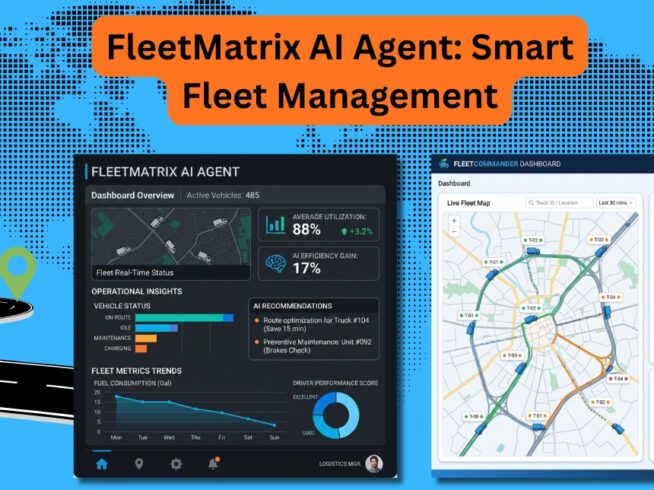
FleetMatrix AI Agent is an intelligent assistant designed for modern fleet operations. It combines artificial intelligence with voice interaction to support drivers and fleet managers with real time insights, alerts, and recommendations.
It is a smart decision-making system that keeps fleets moving efficiently.
Challenges of Fleet Business
Transportation and logistics companies face constant challenges of limited visibility into vehicle movement, unexpected breakdowns, and communication gaps between drivers and managers. Over time, inefficiencies compound, reducing overall fleet performance thus driving up costs.
Yet many businesses still rely on systems that simply display data without enabling meaningful action.
That is where FleetMatrix AI makes the difference.
FleetMatrix Features
🎙️ Voice First Experience
Drivers do not need to look at screens while driving. They can simply speak and get instant updates or share information, making operations safer and smoother.
📍 Live Fleet Visibility
Know exactly where your vehicles are and how trips are progressing without delays or guesswork.
🔧 Smart Maintenance Alerts
Instead of reacting to breakdowns, FleetMatrix helps you stay ahead by identifying issues early and alerting you in advance.
📊 Actionable Insights
You do not just get raw data. You get meaningful insights about routes, fuel usage, and driver performance that you can use to improve operations.
🚛 Better Asset Tracking
From trailers to cargo, everything is tracked in a more organized and intelligent way.
Impact on Business
When you start using FleetMatrix AI agent, the impact becomes clear almost immediately.
Operations run more smoothly as routes are continuously optimized, and delays minimized.
Costs drop because maintenance issues are identified and addressed before they escalate.
Drivers feel better supported, with safer, more predictable journeys.
Customers benefit from accurate, real-time delivery updates they can trust.
This is not about adding more technology for the sake of it. It is about making your existing operations smarter, more responsive, and more efficient.
Cutting-Edge Intelligence
FleetMatrix leverages advanced capabilities like machine learning and natural language processing to analyze data in real-time and respond instantly.
What truly sets it apart is its simplicity.
It is easy to use. You do not need a technical team to adopt it. The system is designed to work naturally with your team, fitting into existing workflows and enhancing how people already operate, helping everyone perform at their best.
Designed to Empower
FleetMatrix AI Agent is built for forward-thinking businesses.
It is built to support logistics companies, transport operators, and delivery services at any scale.
Whether you are managing a small fleet or a complex, multi-location network, it adapts seamlessly to your operations and grows with your needs — bringing clarity, control, and efficiency to every stage of your operations.
What’s Next
The transportation industry is evolving rapidly.
If you want to simplify operations, boost safety, and gain complete control over your fleet, FleetMatrix AI Agent is the way forward.
It is more than vehicle management. It is intelligent management of your entire operation, helping you make smarter decisions, faster.
Businesses that embrace intelligent systems today will be the ones setting the pace tomorrow.
The healthcare industry is under immense pressure. Rising operational costs, staff shortages, and an ever-increasing demand for high-quality care have made it clear that traditional healthcare procedures are not sustainable.
To survive and thrive in this new era, healthcare providers must look toward smarter, technology-driven solutions.
One innovation leading the charge is AI agents, an intelligent digital assistant that do not just automate tasks, but also learn, adapt, and support doctors, nurses, administrators, and patients.
From reducing healthcare costs to improving patient outcomes, AI agents are shaping the future of healthcare delivery.
What Are AI Agents in Healthcare?
AI agents are intelligent software systems that are designed to assist, automate, and enhance various aspects of healthcare. They combine machine learning, natural language processing (NLP), computer vision, predictive analytics, and automation to support healthcare professionals.
In healthcare, AI agents can:
Communicate with patients via chat or voice.
Analyze patient data to detect health risks.
Automate repetitive back-office tasks like billing and scheduling.
Support clinical decision-making by providing insights.
Accelerate drug development process by optimizing clinical trials.
Offer continuous remote monitoring and telemedicine.
Summarize and extract valuable information from medical data.
AI agents use artificial intelligence techniques to make decisions and take actions to achieve goals. They adapt, learn from patterns, and improve over time. Think of them as virtual colleagues who can take on routine workloads so healthcare professionals can focus on critical, high-value tasks.
Why Healthcare Costs Keep Rising
Before we look at how AI agents help, let us understand the challenge.
Healthcare costs are rising due to several factors:
Administrative overload – Around 30% of U.S. healthcare spending goes into administrative processes like claims, billing, and paperwork.
Workforce shortages – Hospitals and clinics worldwide are facing a shortage of doctors, nurses, and support staff.
Chronic disease management – Diabetes, cardiovascular diseases, and cancer require continuous monitoring, making treatment expensive.
Inefficient resource utilization – From unoccupied beds to redundant tests, inefficiencies drive up costs.
Medical errors – Mistakes in diagnosis, prescriptions, or procedures lead to financial and human costs.
AI agents address these pain points directly by cutting inefficiencies, reducing errors, and ensuring better allocation of resources.
How AI Agents Reduce Healthcare Costs
Benefits of AI Agents and their significant impact are seen across various sectors of healthcare industry.
1. Automating Administrative Tasks
Administrative work eats up both time and money. AI agents can manage:
Appointment booking and rescheduling.
Insurance verification and claims processing.
Billing and payment reminders.
By reducing manual workloads, healthcare organizations save on staffing costs and minimize costly human errors.
2. Optimizing Resource Utilization
Hospitals often struggle with capacity planning. AI agents use predictive analytics to:
Forecast patient admission rates.
Manage bed occupancy efficiently.
Track and schedule use of critical equipment.
This ensures no resource goes underutilized while avoiding overbooking or shortages.
3. Preventing Readmissions
Hospital readmissions are costly and often avoidable. AI agents help by:
Monitoring discharged patients remotely.
Sending medication and appointment reminders.
Alerting providers if a patient’s condition worsens.
This proactive approach reduces unnecessary hospital stays and saves significant costs.
4. Speeding Up Clinical Decision-Making
Doctors are often burdened with large amounts of patient data. AI agents can:
Aggregate lab results, imaging reports, and EHR data.
Highlight risk factors or anomalies.
Suggest treatment options based on similar cases.
This accelerates decision-making and prevents unnecessary diagnostic tests.
5. Improved Diagnosis Accuracy
Healthcare systems generate a vast amount of diverse and complex data. AI agents can:
Design personalized treatment plan.
Provide data-driven insights for healthcare management.
Integrate genetic data for effective treatment.
This reduces the likelihood of costly diagnostics errors leading to accurate treatment.
How AI Agents Improve Patient Outcomes
AI agents enhance the quality of patient care.
1. Personalized Patient Care
Every patient is unique. AI agents analyze patient history, lifestyle, and genetic factors to:
Provide tailored treatment plans.
Offer lifestyle recommendations.
Adjust care plans dynamically as new data comes in.
This ensures that patients receive individualized care, not one-size-fits-all solutions.
2. 24/7 Virtual Health Assistance
Imagine a patient feeling unwell at midnight. Instead of waiting for clinic hours, AI-powered chatbots and voice assistants can:
Answer medical queries.
Guide patients on whether to seek urgent care or manage symptoms at home.
Provide emotional reassurance.
This round-the-clock availability improves patient satisfaction and reduces unnecessary ER visits.
3. Remote Patient Monitoring (RPM)
Wearables and IoT devices paired with AI agents allow real-time health monitoring. For example:
A diabetic patient’s glucose levels can be tracked continuously.
Cardiac patients can have heart rate and ECG monitored remotely.
Alerts are sent instantly to caregivers in case of anomalies.
This improves outcomes by ensuring early intervention.
4. Reducing Medical Errors
AI agents act as a second set of eyes for healthcare professionals by:
Cross-checking prescriptions to avoid harmful drug interactions.
Flagging inconsistent diagnoses.
Ensuring adherence to treatment protocols.
With fewer errors, patient safety and trust in healthcare systems improve significantly.
5. Streamline Hospital Operations
AI agents can optimize hospital resources (e.g., beds, staff, medicine, equipment) based on real time data.
Predictive models can forecast patient inflow.
Efficient resource allocation to avoid bottlenecks.
Automating administrative tasks to improve operational efficiency.
This makes healthcare more efficient, personalized, and accessible.
Real-World Examples of AI Agents in Healthcare
Mayo Clinic: Uses AI-powered scheduling systems to reduce wait times and improve staff efficiency.
Babylon Health: Offers an AI chatbot that triages symptoms and directs patients to the appropriate care level.
Philips Healthcare: Employs AI-driven remote monitoring to support chronic disease management.
Johns Hopkins: Leverages AI tools for predicting patient deterioration in ICUs.
Morgan Health: Uses AI to analyze claims and benefits data to improve health program performance.
These examples showcase how AI agents are playing a vital role in healthcare industry.
Challenges to Overcome
Despite their promise, AI agents in healthcare face hurdles:
Data Privacy and Security
Handling patient data requires strict compliance with HIPAA and GDPR regulations.
Integration with Legacy Systems
Many hospitals use outdated IT systems, making integration a challenge.
Patient Trust Some patients feel uneasy about receiving recommendations from AI instead of doctors.
Cost of Implementation Deploying AI systems requires upfront investment, though long-term ROI is positive.
Bias and Fairness AI models can inherit and even amplify existing biases in training data.
Lack of Explainability Many AI systems (especially deep learning models) do not provide transparent reasoning behind decisions.
Addressing these concerns requires careful planning, training, and transparent communication with patients and staff.
The Future of AI Agents in Healthcare
The future of healthcare is smarter, faster, and more personalized. Here is what to expect:
Virtual Nursing Assistants – AI agents will guide patients throughout recovery, reminding them of medication schedules and physical therapy exercises.
Surgeries – Clinical teams will use AI agents during surgeries.
Early Disease Detection – By analyzing subtle patterns in health data, AI agents may spot diseases before symptoms even appear.
Public Health Surveillance – AI agents will help track and manage diseases at community and global level.
Consumer Tech – AI agents will increasingly live in smartphones, wearables and home devices becoming part of daily life.
Fully Integrated EHR Systems – Doctors will receive real-time recommendations as AI agents analyze medical records instantly.
Scalable Telemedicine Support – AI agents will make remote healthcare more accessible and affordable, especially in underserved regions.
The next decade AI agents will become a critical force behind every diagnosis, treatment, and patient interaction.
Final Thoughts
AI agents are already reshaping the future of healthcare not as replacements for healthcare professionals, but as a powerful ally that enhances the efficiency, precision, and reach of medical services.
By cutting down on unnecessary costs and enhancing patient care, they provide a much-needed solution for industry, under immense strain.
AI agents will make healthcare providers more effective, more informed, and more empowered.
The organizations that embrace AI agents thoughtfully and responsibly will provide healthcare that is efficient, affordable, and patient-centered.
In the past, the role of a CXO was defined by experience, intuition, and the ability to interpret reports prepared by teams. But in today’s digital-first world, the landscape has changed.
Data is produced at a speed and volume no human team can fully process. Market trends shift in days, customer preferences evolve overnight, and risks from cybersecurity threats to supply chain disruptions can surface without warning.
For today’s CXOs, the challenge is not just accessing information, it is making sense of it in real time and acting with precision. This is exactly where AI Agents are beginning to redefine executive leadership.
AI Agents are not just tools; they are autonomous systems that analyze, learn, and take proactive actions. Unlike traditional dashboards or analytics platforms, AI Agents can continuously process data, highlight what matters most, and even recommend or execute decisions.
For CXOs, they serve as a digital co-pilot in strategy and operations, bringing clarity to complexity.
What are CXOs?
CXOs is a collective term referring to C-level executives in an organization, the most senior leaders whose titles typically start with “Chief” and end with “Officer.”
The “X” in CXO stands for a variable, representing various executive functions.
Role
Full Title
Area of Responsibility
CEO
Chief Executive Officer
Overall leadership and vision
CFO
Chief Financial Officer
Finance, Budgeting, Risk
COO
Chief Operating Officer
Operations, Execution, Logistics
CTO
Chief Technology Officer
Tech innovation, Product architecture
CIO
Chief Information Officer
IT systems, Infrastructure, Data
CMO
Chief Marketing Officer
Marketing, brand, Customer growth
CHRO
Chief Human Resources Officer
Talent, Culture, HR operations
CISO
Chief Information Security Officer
Cybersecurity, Compliance
CPO
Chief Product Officer
Product roadmap
What are AI Agents for CXOs?
AI agents for CXOs are intelligent, often autonomous, or semi-autonomous systems that:
Analyze large volumes of structured/unstructured data.
Provide real-time insights and recommendations.
Automate repetitive or analytical tasks.
Interact via natural language (chat, voice, dashboards)
Act as advisors, strategists, or digital assistants.
They can be custom-built or deployed via enterprise AI platforms. They are designed to augment decision-making, automate routine tasks, and surface insights to help executives be more strategic, responsive, and efficient.
Examples of AI Agent types
Agent Type
Function
Insight Agent
Aggregates data across silos, delivers executive summaries
Forecasting Agent
Uses Machine Learning to model revenue, growth, or risk
Advisor Agent
Provides strategic recommendations based on data trends
Executive Copilot
Chat-style assistant that answers complex questions
Compliance Agent
Monitors for violations or anomalies in governance
Deal Agent
Flags high-value opportunities in markets, customers, or partners
AI Agent use cases for CXOs
CEO
Real-time business KPIs
Competitive intelligence aggregation
Board meeting preparation
CFO
Financial forecasting
Cash flow optimization
Predictive budget planning
COO
Supply chain optimization
Operational efficiency suggestions
Real-time logistics visibility
CTO
System health monitoring
Tech stack optimization
Cybersecurity threat detection
CMO
Customer sentiment analysis
Campaign performance prediction
Market trend monitoring
CHRO
Workforce planning
Attrition risk modeling
HR operations
The Benefits: From Insights to Impact
One of the most powerful contributions of AI Agents is their ability to make strategy more data driven. AI agents provide real-time business visibility enabling cross-functional alignment, informed and scenario-based decisions.
They also bring speed to leadership. In industries where market conditions change daily, waiting weeks for reports is no longer viable. AI Agents process live data streams, helping CXOs respond instantly to disruptions, be it a supply chain delay, a security threat, or a sudden dip in customer engagement.
AI Agents assist in risk management. By spotting anomalies and predicting potential threats, they give leaders time to act before risks escalate. For instance, a financial AI Agent can flag unusual spending patterns that hint at fraud, while an IT-focused AI Agent can detect a cyber vulnerability before it turns into a breach. This helps with fewer surprises, stronger governance, and improved resilience.
AI Agents deliver operational efficiency. Tasks like compliance checks, reporting, and performance monitoring are automated. This frees up valuable executive time, allowing leaders to focus on strategy, growth, and innovation.
Adopting AI Agents creates a competitive advantage. Companies that leverage AI Agents tend to reach markets faster, respond to emerging trends swifter and innovate quicker.
The real advantage of AI Agents lies in their ability to continuously learn. Unlike static tools, AI Agents adapt to new data, evolving markets, and shifting business needs. Over time, they become more accurate, more personalized, and more valuable to the decision-making process.
Real-World Impact Across the C-Suite
The transformative potential of AI Agents is shaping executive roles:
For CEOs, AI Agents act as a radar for the entire business ecosystem. They continuously monitor competitor moves, customer sentiment, and industry developments offering CEOs the foresight needed to lead with confidence.
For CIOs and CTOs, AI Agents are essential in IT operations and digital transformation. They detect anomalies in complex IT systems, initiate self-healing processes, and optimize cloud resources, ensuring reliability and efficiency.
For CFOs, AI Agents take forecasting to the next level. They provide real-time cash flow predictions, monitor financial compliance, and even recommend investment opportunities based on market data.
For CMOs, AI Agents act as a digital partner for customer understanding. From tracking consumer behavior to personalizing campaigns and monitoring brand reputation online, they help marketing leaders connect with customers in smarter ways.
In each case, AI Agents are not replacing leaders but amplifying their ability to act strategically.
Challenges in Adoption
Integrating AI Agents into executive workflows is not without challenges. Data privacy and security remain top concerns, as sensitive company information must be safeguarded.
Integration with existing legacy systems can also be complex.
Implementing effective AI agents often requires custom development or configuration, clean and unified data pipelines, and ongoing model tuning. This can be costly.
Another challenge is trust. For many leaders, relying on an AI Agent’s recommendation requires a cultural shift. Building this trust involves transparency in how AI makes decisions and ensuring accountability frameworks are in place.
Risk of losing human judgment, ethical reasoning, or creative insight, especially in nuanced or ambiguous situations, is of concern.
AI agents are only as good as the data they are trained or fed with. If data is outdated, incomplete, or biased, it can lead to misleading insights or flawed recommendations.
CXOs must manage organizational change. Employees and stakeholders need to be guided in adopting AI-driven workflows, which require communication, training, and strong leadership.
The Future of AI Agents in the Boardroom
As digital transformation accelerates, AI Agents are poised to become indispensable members of the C-Suite. The future of AI agents for CXOs is about redefining executive leadership itself.
AI agents are evolving from simple assistants into strategic partners, capable of transforming how top executives operate in a complex, fast-moving business world. They will deeply understand each CXO’s goals, work style, preferences, proactively adapting and becoming personalized leadership support.
We can expect to see boardrooms where AI runs real-time simulations of strategic decisions, where multiple agents collaborate across departments to provide unified insights, and where leaders can simply ask questions in natural language and receive instant, data-backed answers.
Conversational interfaces will allow CXOs to interact with data, scenarios, and strategy in plain language, via voice, text, or AR/VR environments.
Agents will generate audit-ready reports, compliance tracking, and real-time board briefings.Ethical AI will be a co-pilot in moral decision-making.
AI-augmented leadership will become the new standard. Organizations that equip CXOs with AI Agents will be at a strategic advantage. The future CXOs who use AI will outperform those who do not. CXOs who embrace AI Agents will set the pace for their industries.
Best Practices for adopting AI Agents for CXOs
To ensure successful adoption, CXOs should:
Begin with small pilot projects in high-value areas.
Focus on quality data since AI is only as reliable as the data it consumes.
Collaborate with IT and data teams for secure and seamless integration.
Continuously track ROI, measuring improvements in speed, efficiency, and decision accuracy.
By approaching AI adoption strategically, CXOs can maximize the value of AI Agents while minimizing risks.
Conclusion
For modern executives, success depends on making smarter, faster, and more data-driven decisions. AI Agents bring this capability to life, offering clarity in complexity, foresight in uncertainty, and efficiency in execution.
AI Agents empower CXOs to lead with greater confidence, precision, focus, and agility. The organizations that embrace AI Agents will not only solve today’s challenges but also shape tomorrow’s world.
The future of leadership is human + AI working together.
Voice AI refers to artificial intelligence systems powered by natural language processing (NLP) that enable users to interact using spoken commands. Unlike basic voice recognition tools, Voice AI can understand context, intent, and even nuances in speech, making it ideal for environments where accuracy and clarity are vital.
Voice AI has a wide range of applications across various industries:
Healthcare: Patients can use Voice AI to fill out intake forms, update medical history, or schedule appointments.
Customer Service: Voice AI can guide customers through filling out forms for a return, a claim, or a technical support request.
Human Resources: Employees can use Voice AI to fill out expense reports, performance reviews, or personal information updates.
E-commerce: Customers can complete shipping and billing information forms using voice commands, especially on mobile devices.
Surveys and Research: Researchers can collect qualitative data through voice-based surveys, with the AI transcribing and structuring the responses for easy analysis.
Voice AI in Healthcare
Voice AI is a hands-free technology that allows healthcare providers to fill out forms, access records, and track patient information using simple voice commands. It reduces documentation time, improves patient engagement, assists in triage, and streamlines workflows.
Administrative burden on Healthcare
Healthcare professionals are drowning in paperwork. Studies show that doctors spend over 30% of their time on administrative tasks, including data entry, form filling, and managing electronic health records (EHRs). This not only affects the quality of care but also contributes to burnout, inefficiency, and rising operational costs.
Benefits of using Voice AI in Healthcare
Benefits documented in recent studies and practice include:
Increased Efficiency: Reduces the time spent on manual data entry for both patients and staff. Some organizations have reported a 30% gain in operational efficiency within six months of implementation.
Enhanced Accessibility: Makes form-filling accessible to patients with limited mobility, visual impairment, or those who are not tech-savvy. Voice AI also offers support for multilingual interactions, ensuring that a more diverse patient population can communicate effectively.
Improved Accuracy: AI-powered systems can recognize and accurately transcribe complex medical terminology, reducing the risk of human transcription errors. The system can also ask clarifying questions to ensure the information is correct before it is saved.
Better Patient Experience: Patients appreciate the convenience of completing forms from home and the reduced waiting times at the clinic. Providers are no longer tethered to a keyboard and can have more focused, empathetic conversations with their patients.
HIPAA Compliance: Top-tier Voice AI solutions for healthcare are built to be HIPAA-compliant, ensuring that sensitive patient data is managed with the utmost security and privacy through features like end-to-end encryption and secure data storage.
Key Applications in Healthcare
Voice AI hands-free technology has numerous applications in the healthcare industry.
Appointment Scheduling and Reminders: Voice AI-powered virtual assistants can handle bookings, rescheduling, and canceling appointments, as well as sending automated reminders to patients. This reduces the administrative burden on staff and helps lower no-show rates.
Patient Triage and Intake: AI can gather preliminary patient information, assess symptoms, and determine the urgency of a situation. This helps route patients to the correct department or provider more efficiently, improving emergency response and resource allocation.
Automating Routine Tasks: Voice AI can handle a wide range of common inquiries, such as questions about insurance, billing, prescription refills, and medical records, freeing up staff to focus on more complex patient needs.
Real-time Transcription: Voice AI systems can accurately transcribe conversations between doctors and patients during consultations. This automatically generates clinical notes and updates electronic health records (EHRs), saving significant time for healthcare professionals who often spend a large portion of their day on documentation.
Hands-free Operation: In sterile environments like operating rooms or emergency departments, voice-controlled systems allow clinicians to access patient data or record notes without touching a device, improving both safety and speed.
24/7 Patient Access: Voice AI chatbots and interactive voice response (IVR) systems provide round-the-clock support, allowing patients to get answers to their questions, schedule appointments, or receive medication reminders at any time. This is particularly beneficial for elderly patients, those with disabilities, or people in rural areas.
Medication Management: Voice assistants can act as a “gentle, reliable companion,” reminding patients to take their medications, providing dosage instructions, and even flagging potential side effects. This is especially helpful for patients with chronic illnesses who need to adhere to a strict regimen.
Remote Monitoring and Telemedicine: Voice AI is playing a key role in remote patient monitoring by collecting data and communicating with patients to track their health without the need for in-person visits. This is crucial for managing chronic conditions and providing post-discharge care.
Mental Health Support: AI-powered voice assistants can offer immediate access to mental health resources, provide guided coping strategies, and monitor a patient’s mental health over time.
Ongoing research aims to completely address potential challenges in Voice AI technology.
Ethical, privacy, and data protection concerns remain prominent as Voice AI captures sensitive patient information.
Industry stakeholders stress the need for inclusive datasets, robust validation, and continuous monitoring to avoid bias and ensure equitable outcomes.
Standardization and integration with existing IT systems are ongoing challenges as technology rapidly evolves.
Future of Voice AI in Healthcare
The global Voice AI healthcare market is forecasted to grow at an annual rate above 35% by 2030, with over 30% of healthcare organizations already using voice AI for diagnosis, patient monitoring, telehealth, and more.
As models become more accurate and integrated with hospital management systems, we can expect:
Full conversational AI-powered virtual agents
Voice-enabled EHRs and CRM systems
AI scribing for real-time documentation
Predictive alerts through conversational AI
With growing investment and adoption, Voice AI is positioned to become a standard tool in every healthcare setting, from private clinics to large multi-specialty hospitals.
Conclusion: Embracing a Hands-Free Future
Voice AI offers a scalable, efficient, and intelligent solutionto reduce operational cost while improving patient outcome. This hands-free technology is redefining how care is delivered by creating a more human, connected, and responsive system that puts patients first.
In the rapidly evolving landscape of artificial intelligence, Microsoft has introduced a game-changing platform that’s transforming how developers and organizations build, deploy, and manage AI applications. Azure AI Foundry represents a comprehensive solution for AI development that combines cutting-edge tools, pre-built models, and enterprise-grade infrastructure to accelerate AI innovation across industries.
In the fast-evolving digital landscape, businesses are continually seeking ways to enhance efficiency, reduce costs, and improve customer experiences.
AI agents for business have emerged as a game-changing solution, offering automation, real-time insights, and smarter decision-making capabilities. From customer service chatbots to intelligent virtual assistants and workflow automation tools, AI agents are revolutionizing the way companies operate.